From Surveillance to Strike: How IP Camera Leaks Shape Modern Cyber Warfare
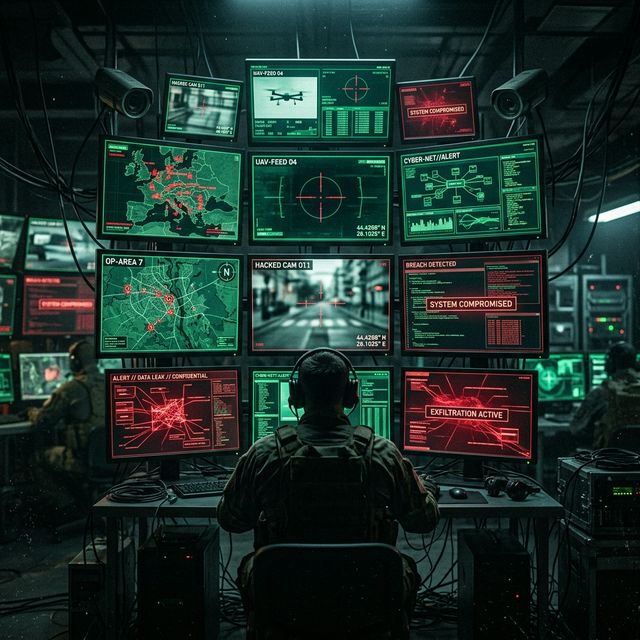
In traditional warfare, intelligence gathering required eyes on the ground or expensive satellite arrays. Today, the battlefield has evolved, and the "eyes" are often already there, mounted on street corners, residential buildings, and critical infrastructure. The weaponization of internet-connected IP cameras has transformed digital surveillance vulnerabilities into devastating tactical advantages for state actors and military strategists.
No longer just a tool for petty cybercrime, IP camera data leaks are now actively used to coordinate direct attacks, adjust missile trajectories, and execute high-profile assassinations. The interconnectedness of our global infrastructure means that an unsecured camera in a civilian neighborhood can unwittingly become a crucial node in a military operation.
The Russian-Ukrainian Digital Front
One of the most documented and profound examples of IP cameras being integrated into wartime strategy is the ongoing conflict in Ukraine. Russian intelligence services (such as the GRU) quickly identified the tactical value of Ukraine's vast network of civilian and commercial security cameras.
By exploiting default passwords, outdated firmware, and exposed ports, hackers have routinely compromised internet-connected cameras. According to the Security Service of Ukraine (SBU), over 10,000 IP cameras that posed a security risk have been blocked or dismantled since the invasion began. The operational methods are brutally effective:
- Real-Time Targeting: Hackers pivot the camera's viewing angle to observe power facilities, railway stations, and logistical hubs.
- Missile Adjustments: Visual intelligence from these hacked feeds is used to track air defense systems and assess the immediate impact of strikes, allowing for precise adjustments in subsequent attacks.
- Cross-Border Espionage: This digital dragnet extends into neighboring countries like Poland and Romania, where cameras are hijacked to track the flow of Western military aid entering Ukraine.
Assassinations and High-Tech Espionage: The "Pattern of Life"
The lethal potential of surveillance technology extends beyond broad military strikes to highly targeted, surgical operations. The Middle East has been a prominent testing ground for this terrifying intersection of cyber and kinetic warfare.
One of the most staggering examples materialized on February 28, 2026, during the deeply consequential joint US-Israeli air strike that targeted a compound in Tehran, resulting in the assassination of Iran's Supreme Leader, Ayatollah Ali Khamenei. Reports indicate that hacked IP-based traffic and surveillance cameras played the central role in tracking his movements and sealing his fate.
Israeli intelligence, specifically Mossad, reportedly infiltrated Tehran's extensive traffic camera network years prior to the attack. This massive breach provided several critical tactical advantages:
- Long-Term Monitoring: Hackers continuously accessed thousands of Iranian surveillance feeds, analyzing the daily routines of Khamenei, his bodyguards, and senior officials.
- "Pattern of Life" Analysis: Intelligence agencies used advanced AI tools to parse massive volumes of video data, establishing detailed behavioral routines and accurately predicting when officials would be present at specific locations.
- Specific Camera Access: A single compromised camera provided a direct, overarching view of the parking area at the target compound, enabling real-time verification of security personnel and VIP vehicles directly preceding the strike.
- Simultaneous Cyber Disruption: Alongside the camera hacks, operatives reportedly jammed and disrupted cellular service near the compound right before the strike, preventing the security detail from receiving early warnings or calling for emergency support.
This event highlighted a pressing 21st-century security dilemma: the very surveillance infrastructure built by authoritarian states to monitor their own citizens can be flawlessly leveraged against them by external actors. Just like the 2020 assassination of Iranian scientist Mohsen Fakhrizadeh—which prominently utilized a remote-controlled machine gun guided by live camera feeds—these incidents prove that digital camera infiltration is now the backbone of modern physical decapitation strikes.
The Unseen Threat of the "Internet of Things"
What makes these incidents so alarming is the mundanity of the exploited devices. A coffee shop's security camera or a residential smart doorbell can become an espionage tool. The ripple effects of these breaches demonstrate that digital sovereignty is no longer just about protecting data—it is about physical survival.
When consumer-grade IoT devices are left with default security settings, or when localized NVR systems are needlessly exposed to the public internet, they become an intelligence goldmine for hostile actors. The weaponization of IP cameras illustrates a stark reality: Cybersecurity is now a fundamental component of national security.
The Antidote to State-Sponsored Hacks: OpenNVR
Mitigating these catastrophic threats requires a total paradigm shift in how we design surveillance networks. Traditional cloud-tethered CCTV architectures and NVRs with proprietary remote-access "convenience" features are fundamentally unequipped to survive modern cyber warfare.
This is exactly where OpenNVR emerges as the definitive solution. Built entirely around the philosophy of Digital Sovereignty, OpenNVR directly neutralizes the vectors exploited by intelligence agencies:
- Network-Isolated Architectures: OpenNVR strips away forced cloud dependencies and external data transmission. Surveillance networks are inherently isolated from the public internet, making remote "Pattern of Life" aggregation impossible.
- Absolute On-Premise Control: Video streams never leave the facility unless explicitly mandated through heavily encrypted, vetted tunnels. Nation-state actors cannot hijack traffic cameras if the data is securely siloed.
- Zero-Trust Frameworks: By enforcing strict network access controls without inbound port forwarding, OpenNVR defends against the brute-force attacks and firmware exploits that crippled infrastructures like those in Ukraine and Tehran.
As warfare increasingly blurs the line between the physical and the digital, an unpatched or cloud-exposed IP camera is no longer just a privacy risk—it is a lethal, tactical liability. OpenNVR ensures that the surveillance infrastructure you built to protect your assets never becomes the weapon used against you.