Robots, unmanned vehicles and the cameras that move: where OpenNVR fits
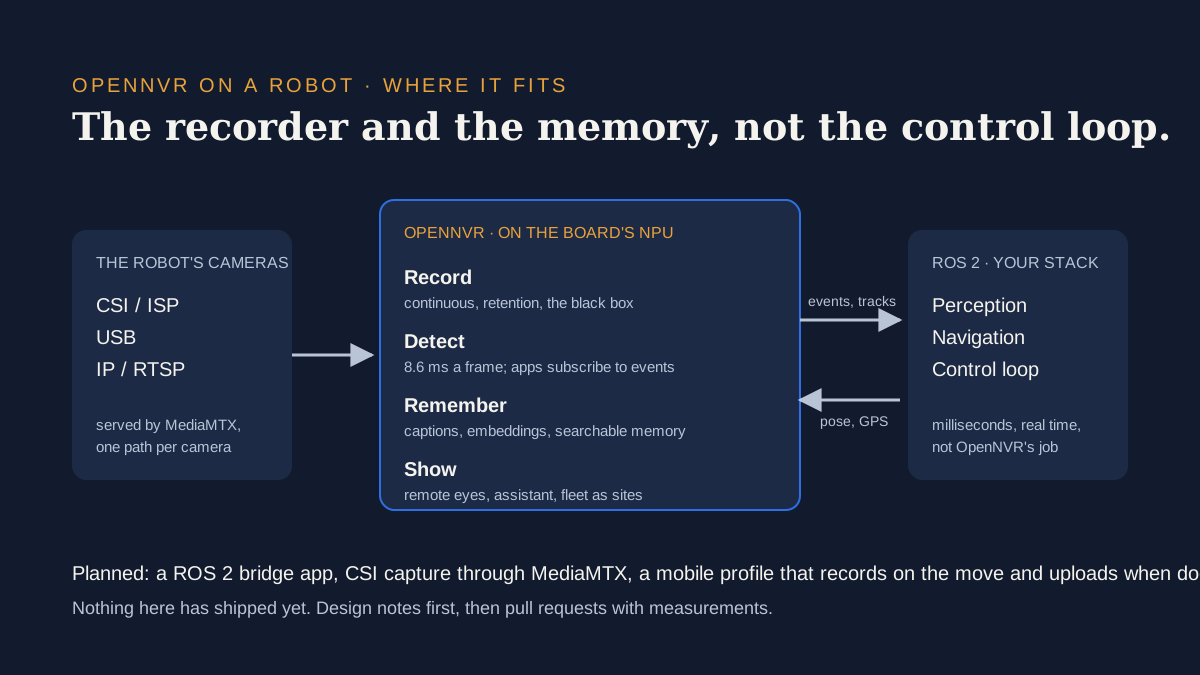
Now that OpenNVR runs its whole AI stack on a Qualcomm Dragonwing board, a question we had parked is back on the table: what does a robot, a delivery vehicle or an inspection drone want from its cameras that a building does not? Our answer, after looking at what those teams actually ask of their footage, is "less than you would think, and most of it is what we already do". This post is where we think OpenNVR fits, what we plan to build, and, as importantly, what we will not.
What we are not: the control loop
A robot's perception stack, the part that turns camera frames into "obstacle at 1.2 m, steer left" within a few milliseconds, belongs to ROS 2 and the people who build the robot. We have no intention of competing there, and a video platform with a database, a web UI and an audit log has no business in a control loop. OpenNVR's place is the layer those teams do not want to write and keep rewriting: everything that happens to the footage after perception has had its look.
What a robot gets from OpenNVR today, unchanged
- A black box. Continuous recording of every camera, with retention, pause and purge rules, so when a vehicle hits something or a robot stalls there is footage, with the detections that were made at the time, not a reconstruction.
- A memory you can search. Every detection becomes an event with a crop, a caption and an embedding, so "when did we last see a pallet left in aisle four" or "show me every person who approached the vehicle while it was parked" is a query, not a scrub through hours of video. On the Ventuno Q the captioner and the embedder run on the NPU at under two seconds a photo.
- Remote eyes. Live streams, snapshots and an assistant you can ask "what is the robot looking at right now", over the same authenticated API a building operator uses, from wherever the operator sits.
- A fleet is a multi-site. OpenNVR already treats sites, cameras and permissions as a tree. A fleet of twenty vehicles is twenty sites with a few cameras each; the dashboards, the alerts and the audit log are the same code.
- Apps that subscribe, not integrate. Intrusion, loitering, line crossing, plate reading, PPE checks and the rest consume the detector's events. A robot patrolling a warehouse at night runs the same intrusion app a fixed camera would, with the robot's position attached.
Why the Ventuno Q is the board to do it on
Arduino built the Ventuno Q for exactly this use: three MIPI CSI camera inputs with an image signal processor, a real-time microcontroller beside the application cores, CAN-FD, NVMe storage, 16 GB of memory, and the Hexagon NPU we have now measured across every role in our stack. A board that records sixteen IP cameras with the cores 40% idle has room to be a vehicle's recorder and memory with the perception stack running beside it. The comparison board people ask about is NVIDIA's Jetson Orin Nano, which has more raw NPU throughput and the CUDA ecosystem; we will measure OpenNVR there too when the nvidia flavour ships, and the point of OpenNVR's flavour design is that the choice stays yours.
What we plan to build, in order
| Step | What | Why first |
|---|---|---|
| 1 | A ROS 2 bridge, as an example app. Detections, tracks and events published as ROS topics; pose and GPS subscribed, so every event and every piece of evidence carries where the robot was when it saw it. | It is the integration every robotics team would otherwise write, and it needs nothing new in the core: apps already consume events and can enrich them. |
| 2 | CSI camera capture. The board's own cameras served through MediaMTX exactly as a USB webcam is today, with the capture command chosen per hardware flavour (Qualcomm's GStreamer source on Dragonwing, Argus on Jetson, V4L2 elsewhere), and the hardware encoder measured before we rely on it. | A robot's cameras are rarely IP cameras. This is the webcam design extended, not a new path. |
| 3 | A mobile profile. Record on the vehicle, upload when docked or on Wi-Fi, keep the index local so search works offline, and a map view that places events where they happened. | Connectivity on a moving platform is intermittent by nature; the platform has to be offline-first, which OpenNVR already is for a building. |
None of this has shipped. We start after the current release and the hardware work it depends on: the CSI path needs the same Qualcomm video driver fixes we are working through with Indus Technologies and Arduino for decode. Each step will arrive the way the rest of OpenNVR does, as a design note first, then a pull request with measurements.
Who we would like to hear from
If you build robots, unmanned ground or surface vehicles, inspection drones, or the fleets that run them, and the recording-and-memory layer is something you keep writing yourself, we would like to compare notes before we fix the design: which topics you would want published, what your docking and upload pattern looks like, which boards you are on. The community page has the channels; contact@opennvr.org reaches us directly. The earlier you tell us where this is wrong, the less we build twice.