OpenNVR runs on the Arduino Ventuno Q, with its AI on Qualcomm's Hexagon NPU
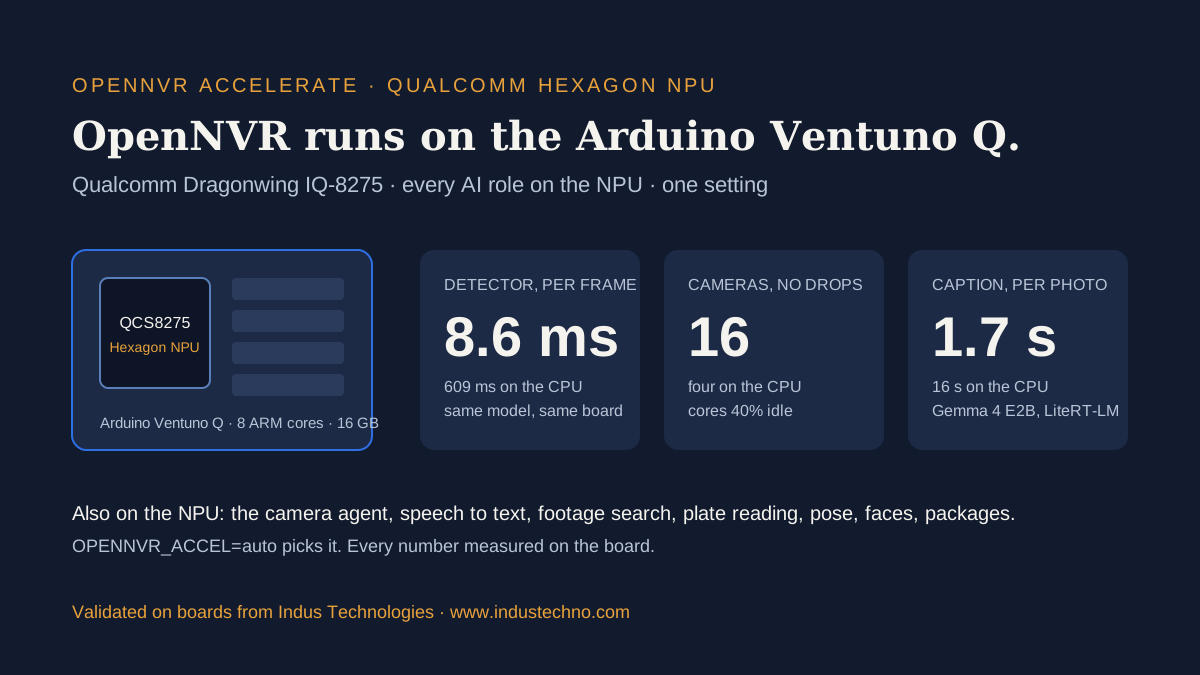
OpenNVR now runs natively on the Arduino Ventuno Q, the single-board computer built on Qualcomm's Dragonwing IQ-8275 (QCS8275). It is the first board where every AI role in the stack runs on an NPU: the always-on detector, the captioner, the camera agent's language model, speech to text, the search embedder and the plate reader all execute on the Hexagon, and the ARM cores are left to decode video. Support shipped in release 0.1.9 on 31 October and has grown with every release since. The platform is the same OpenNVR: the same images, the same apps, one setting.
What runs on the NPU today
Every line below was measured on the board, not read off a datasheet. The full numbers, with the CPU baseline beside each, are in the benchmark post and in the repository's bench folder.
| Role | Model | On the Hexagon |
|---|---|---|
| Always-on detector (Tier-0) | YOLO26n | 8.6 ms an inference; sixteen cameras at 2 fps with no dropped frames, where the CPU managed four |
| Captions and visual questions | Gemma 4 E2B via LiteRT-LM | 1.6 to 1.8 s a photo, against 16 s for the smallest CPU vision model |
| Camera agent (chat, tools) | the same Gemma bundle | 0.6 to 3 s a turn, 96 of 96 on the agent's live evaluation |
| Speech to text | Whisper Small (w8a16) | 361 ms an utterance, equal accuracy to the CPU default at half the time |
| Footage search | SigLIP 2 (w8a16) | 6 to 8 ms a frame, 4 to 6 ms a query |
| Plate reading, pose, faces, packages, object detection | the ONNX adapters | two to eight times faster than on the ARM cores, end to end |
The apps built on those roles come with them: Footage Search, License Plate Recognition, Occupancy Counting, the camera agent and the rest of the catalog run unchanged. An app never touches hardware; it consumes events, so acceleration is never the app's problem.
One setting
Install OpenNVR on the board's Ubuntu the way you would anywhere else. The installer and start.sh look for the Hexagon compute DSP at /dev/fastrpc-cdsp; when they find it, OPENNVR_ACCEL=auto (the default) selects the qualcomm flavour: the detector image and each adapter image with a -qualcomm tag, which carry the ONNX Runtime QNN plugin, and a compose overlay that lends the containers the DSP and the two DMA heaps. Nothing is installed on the host beyond Docker. The first start compiles each model's graph for the NPU once (six seconds for the detector, about two minutes for the plate reader) and downloads the Gemma bundle; after that the compiled graphs are cached and the stack comes up in seconds.
Every start prints what it decided, and every fallback is visible rather than silent: if a model could not be placed on the NPU the service logs an error and reports it in its metrics and health, so "accelerated on paper, running on CPU" cannot hide. The dashboard shows the NPU beside CPU, memory and disk, including when requests are queueing behind each other.
What is not there yet
- Video decode is still software. The chip has a hardware decoder (the Iris video core) and Linux exposes it, but the ffmpeg path produces no frames on the board's current kernel; the fix is upstream and we are working through it with Indus and Arduino. Decode is the cost that scales with cameras on this board, so this is the item we most want closed. Until then, use your cameras' substreams for detection, which OpenNVR does by itself when a camera has one.
- One NPU, shared. The detector, the captioner and the plate reader all queue on the same device. A caption holds it for about a second, during which a detector inference takes five times longer. OpenNVR keeps the detector first in line, and a busy site can keep captions off on its plate cameras; a scheduler that makes captions yield to the detector is the next piece of work.
- Open-vocabulary detection and the CPU vision models stay on the ARM cores. They work, slowly. The Gemma captioner is the NPU answer for questions about a frame.
Thank you, Indus Technologies
None of this would have been measured without Indus Technologies. They put a Ventuno Q on our network before we had written a line for it, ran OpenNVR on it themselves first, answered the hardware questions that only someone who knows the platform can answer, and took on our findings about the board's video decoder. A port like this is mostly finding out which device nodes, libraries and firmware a container has to borrow from the host, and that is work you cannot do without the board in front of you and a partner who knows it. If you are building on Qualcomm Dragonwing or Snapdragon boards in India and need hardware, integration or support, they are the people to talk to.
Indus Technologies
Web: www.industechno.com
Try it, and tell us what you measure
The support matrix, the host requirements and the benchmark protocol are in docs/HARDWARE.md. The same flavour should work on other Dragonwing and Snapdragon boards running Qualcomm's Ubuntu, with one caveat: the Gemma bundle is compiled for the QCS8275's Hexagon v75, so a different SoC needs its own bundle while everything else carries over. If you run OpenNVR on a board we have not measured, a pull request with your numbers is the most useful thing you can send us; if you make such boards, lend us one or give us remote access and we will do the measuring and publish it. Where OpenNVR goes from here on boards like this one, robots and vehicles included, is in the next post.