Why a Hexagon NPU board can be the better edge choice for an NVR: the Arduino Ventuno Q against the Jetson Orin Nano Super, the Raspberry Pi 5 with the AI HAT+ and an Intel mini PC
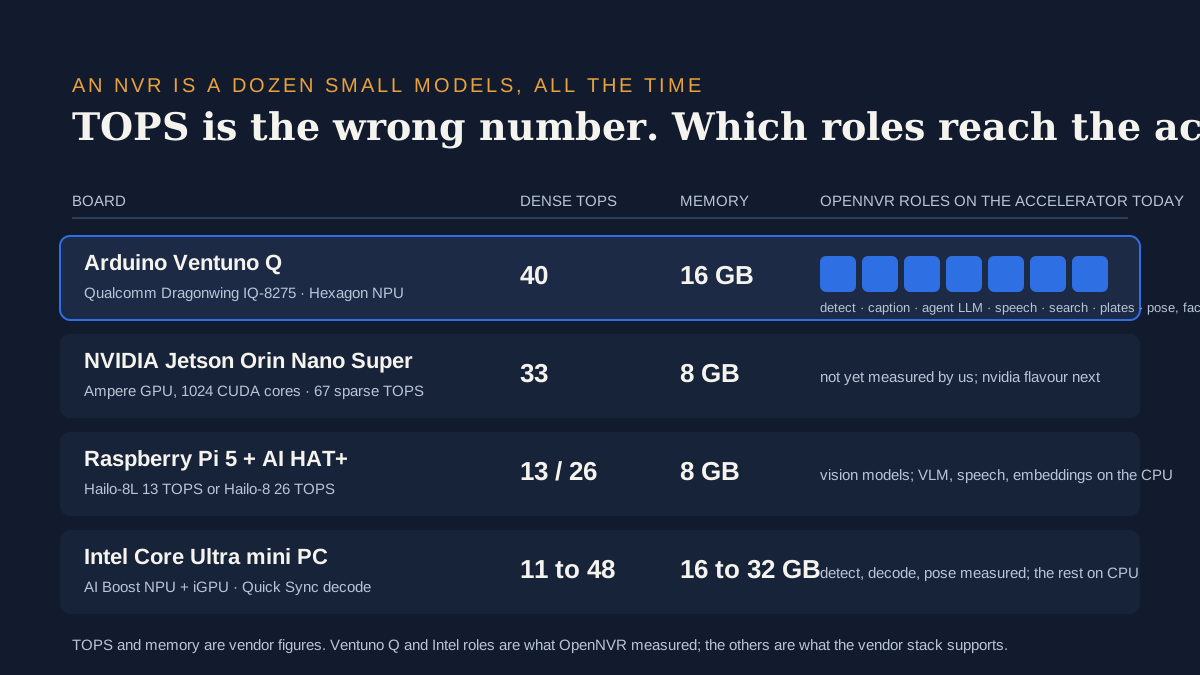
People ask us which board to buy for OpenNVR, and the question usually arrives with a TOPS number attached. After two weeks of measuring every role of our stack on the Arduino Ventuno Q, and a month earlier on an Intel Core Ultra desktop, we think TOPS is the wrong number for this workload, and that a Qualcomm Hexagon board is the better choice for more sites than its spec sheet suggests. This post says why, names the alternatives exactly, and is honest about where the Ventuno Q loses.
A note on numbers. Everything we say about the Ventuno Q and the Intel desktop was measured by us; the reports are linked. Everything about the Jetson, the Raspberry Pi and the Intel mobile chips is the vendor's published figure, marked as such, because we have not run OpenNVR on them yet. We will, when the nvidia flavour ships, and this post will be corrected if the measurements disagree.
What an NVR actually asks of a board
A camera platform is not one big model run once. It is a dozen small models run all the time, beside video decode, a database and a web server, for years, in a cabinet:
- An always-on detector at 2 fps on every camera, which must never fall behind, because a dropped frame is an event that never existed.
- Several models on demand: a captioner for every event, an embedder for search, a plate reader on the gate camera, pose for the guard check, faces at the door, a language model for the assistant, speech to text for the microphone.
- Video decode for every stream, which on most boards costs more than the detector does.
- Memory for all of it at once. The models above are resident together; they are not swapped in and out.
- Twenty-four hours a day, for the life of the installation, which means thermal headroom, an operating system with a long support window, and a chip the vendor will still sell in five years.
Peak INT8 TOPS says something about the first item and little about the rest. What matters is whether each model in that list has a path to the accelerator today, how much memory is left when they are all loaded, and whether the board stays up.
The four contenders, by their exact names
| Board | Accelerator (vendor figure) | CPU | Memory | Launch price (vendor) |
|---|---|---|---|---|
| Arduino Ventuno Q: Qualcomm Dragonwing IQ-8275 (QCS8275) | Hexagon NPU, 40 dense TOPS; Adreno 623 GPU | 8 cores (Kryo Gen 6, Cortex-A78 and A55) | 16 GB LPDDR5, 64 GB eMMC, M.2 NVMe | US$299 introductory; check the Arduino store for today's price |
| NVIDIA Jetson Orin Nano Super Developer Kit | Ampere GPU, 1024 CUDA cores and 32 Tensor cores; 67 sparse / 33 dense INT8 TOPS | 6 cores (Cortex-A78AE) | 8 GB LPDDR5, microSD or NVMe | US$249 |
| Raspberry Pi 5 with the Raspberry Pi AI HAT+ | Hailo-8L, 13 TOPS, or Hailo-8, 26 TOPS, over PCIe | 4 cores (Cortex-A76) | up to 16 GB LPDDR4X | HAT US$70 or US$110, plus the Pi |
| Intel Core Ultra mini PC (Meteor Lake 100 series, Arrow Lake 200 series, Lunar Lake 200V) | Intel AI Boost NPU: about 11 TOPS (Meteor Lake), 13 (Arrow Lake-S), 48 (Lunar Lake); plus the iGPU | varies, x86 | varies, typically 16 to 32 GB | varies widely |
The Intel N100 mini PCs many people start with have no NPU at all; on those OpenNVR decodes on the iGPU and detects on the CPU. The Ventuno Q's 40 TOPS is a dense figure; NVIDIA's headline 67 is a sparse figure whose dense equivalent is 33. Read on the same basis the two are closer than the headlines say.
Where the Ventuno Q is the better choice
1. Every role has a model on the NPU today, and we measured each one
This is the argument that decided it for us. On the Ventuno Q the always-on detector, the captioner, the camera agent's language model, speech to text, the search embedder and the plate, pose, face and package adapters all run on the Hexagon, through three stacks that already exist: ONNX Runtime's QNN plugin for the ONNX models, Qualcomm AI Hub's precompiled bundles (Whisper Small and SigLIP 2 came from there, built for this exact chip) and Google's LiteRT-LM for Gemma 4 E2B, which Google and Qualcomm compiled for the QCS8275. Nothing was trained or converted by hand; we downloaded, pinned a few input shapes and measured. The detector does an inference in 8.6 ms. For comparison, the NPU in a desktop Intel Core Ultra 9 285K, a 24-core chip in a tower case, did the same model in 7.4 ms in our Intel measurements. A credit-card-class industrial board matching a desktop NPU on the one model that runs on every frame is the fact to take from this section.
On the Jetson every one of those models has a CUDA path too, and more of them: the CUDA ecosystem is wider than the Hexagon's, and a team with its own PyTorch models will find the Jetson easier. On the Raspberry Pi AI HAT+ the Hailo chip runs detection, pose and similar vision models well, but a vision-language model, Whisper and a text embedder on it are not things we have seen demonstrated at useful speed; those would fall to the Pi 5's four Cortex-A76 cores, where our measurements on four-core CPUs put a caption at 16 s and a Whisper utterance at over a second.
2. Sixteen gigabytes, and the whole stack needs them
Resident memory on the Ventuno Q while everything ran: the Gemma captioner 1.3 GiB, the SigLIP 2 embedder 2.7 GiB, the core service about 1.4 GB, the detector pipeline, the database, MediaMTX and the apps beside them; the box sat at 10.9 GB used of 15.3 visible, and 5.4 GB of that was a CPU language model we had left loaded for comparison. Take that out and the AI stack with a few apps wants roughly 5 to 6 GB with room to breathe. The Jetson Orin Nano Super ships with 8 GB, shared between the CPU and the GPU. It can run the detector and a captioner; it cannot run the detector, the captioner, the embedder, the agent's LLM and the plate reader resident at once with the margin an always-on box needs. Memory, not TOPS, is the Jetson's limit for this workload, and it is not an upgradeable part.
3. The ARM cores are left alone
With sixteen cameras detected at 2 fps on the NPU the Ventuno Q's cores were 40% idle, and that remaining load was software video decode. The NPU does not share a thermal or power budget with the CPU the way a GPU does, so the cores are available for decode, the database and the apps. On the same board with the detector on the CPU, four cameras were the limit.
4. It is built to be installed, not demonstrated
Qualcomm sells the IQ-8275 as an industrial part with a stated product longevity of ten years or more, and Canonical certified Ubuntu 24.04 LTS for it in September 2026. OpenNVR runs on it entirely in Docker containers on that Ubuntu; nothing is installed on the host, and the same images carry a -qualcomm tag the installer picks by itself. The board has three MIPI CSI camera inputs with an image signal processor, an STM32H5 real-time microcontroller beside the application cores, CAN-FD, NVMe and Gigabit Ethernet, which is the list a vehicle, a gate controller or a factory cell asks for and a developer kit does not carry. Under a real H.265 camera for half an hour the SoC read 42 °C. The Jetson developer kit is a developer kit; a deployable Jetson is a module on a carrier board from another vendor, at a different price. The Raspberry Pi 5 is deployable and cheap, and is the right answer for a small site, but it is a consumer board with a consumer thermal design. An Intel mini PC in a closed cabinet needs airflow: under accelerator load our Core Ultra 9 desktop ran at 95 to 99 °C and tripped twice, and that was a tower with a fan.
5. The accelerator is honest
This is a property of the software as much as the chip, but the Hexagon stack made it possible: every OpenNVR service reports the provider it asked for and the one it got, the compiled graph cache proves the NPU took the model, and a fallback to CPU is an error in the log, never a silent slowdown. The dashboard shows the NPU beside CPU, memory and disk and says when requests are queued. When we got this wrong during the port (a missing library, a provider named instead of attached) the service ran on the CPU while claiming the NPU, and the only reason we caught it was that we checked. Now the platform checks.
Where it is not the better choice
- Hardware video decode, today. This is the Ventuno Q's real weakness for an NVR. The chip has an Iris video core and Linux exposes it, but the ffmpeg path produces no frames on the board's current kernel; the fix is upstream and not yet on the board. Every stream is decoded in software, at about a quarter of a core for an H.265 1080-line main stream. The Jetson's NVDEC, the Raspberry Pi 5's HEVC decoder and Intel's Quick Sync all work with OpenNVR now. Until the kernel lands, detect on your cameras' substreams, which OpenNVR does by itself, and budget ten to twelve main-stream cameras rather than forty.
- Your own models. If your team trains models and ships them as PyTorch, the Jetson's CUDA path is the shorter one. On the Hexagon a model must be exported to ONNX with fixed shapes, or compiled through Qualcomm's tools; our adapter SDK pins shapes for you, but a dynamic graph will not compile and an unusual operator will fall to the CPU.
- The language model's window. The Gemma bundle for this chip has a 4,096-token context fixed at compile time. It carries the camera agent's tools and a short history; it does not carry a long document. A bigger window needs a different compiled bundle.
- One NPU, shared. A caption holds the Hexagon for about a second, during which a detector inference takes five times longer. The Jetson's GPU time-slices more gracefully. OpenNVR keeps the detector first in line and lets you turn captions off per camera; a scheduler that makes captions yield is the next thing we build.
- A small site. For four cameras and no assistant, a Raspberry Pi 5 with the 13 TOPS AI HAT+ costs a fraction of the Ventuno Q and will do the job once OpenNVR's Hailo path ships; today it runs the detector on the Pi's CPU. The Ventuno Q earns its price when the site wants the whole stack: search, captions, the assistant, plates.
- Open-vocabulary detection ("alert me on a red forklift") stays on the ARM cores on every board here except, in principle, the Jetson. It works; it is slow.
Which to pick
| Site | Our pick | Why |
|---|---|---|
| Up to eight cameras, recording and detection, maybe the plate app, in a cabinet or on a vehicle | Arduino Ventuno Q | the whole stack on the NPU, 16 GB, industrial I/O, ten-year part, containers only |
| Up to forty cameras on substreams with search, captions and the assistant | Arduino Ventuno Q once hardware decode lands; an Intel Core Ultra mini PC until then | decode is the cost that scales with cameras, and Intel's Quick Sync path is measured and shipped |
| A research robot or a team with its own PyTorch models | NVIDIA Jetson Orin Nano Super | CUDA; accept the 8 GB and pick which models stay resident |
| A home or a shop with four cameras and no assistant | Raspberry Pi 5, with the AI HAT+ when our Hailo path ships | cost; hardware HEVC decode works today |
| A hundred cameras | an Intel Core Ultra or a desktop with an NVIDIA GPU | decode bandwidth and memory, with the thermal design to match |
We will keep this honest as we measure more boards. The protocol is in docs/HARDWARE.md, every Ventuno Q report is in bench/, and the boards were lent by Indus Technologies, to whom the announcement says thank you properly. If you have one of the other boards and an afternoon, the same protocol gives you a row, and we would rather publish your measurement than our guess. If you make one of these boards, lend it to us and the row will be ours.